RoslinCT Blog Series: Why iPSC Culture Optimisation Is About More Than Growth Rate
Based on a study conducted by Dipta Sengupta, Senior Process Development Scientist, Arlene Ross, Laboratory Technician II, Eva Leal Moreira da Mota, Laboratory Assistant, Emma Rigby, Associate Principal Development Scientist, Reena Rathod, Associate Principal Development Scientist – Cell Processing Lead and Angus Bancroft, Development Manager
When developing an induced pluripotent stem cell (iPSC) process, growth rate is an obvious measure of performance. But it is only one part of the picture.
The choice of culture medium and extracellular matrix can influence not only how quickly cells expand, but also their morphology, consistency, feeding requirements and ultimately the cost and operational efficiency of the process.
For cell therapy developers working towards more scalable and reproducible manufacturing, understanding these trade-offs early can make a meaningful difference later.
To explore this, scientists at RoslinCT compared a range of culture media and matrix combinations using the ROSi001-D iPSC line, assessing their impact on cell health and morphology, growth rate, doubling time and cost efficiency.
Looking Beyond a Single Culture Parameter
The study compared four commonly used media:
- Essential 8 (E8)
- E8 Flex
- StemFlex
- mTeSR Plus
Each was evaluated in combination with either Vitronectin or Laminin-521.
These media and matrices were selected to represent commonly used iPSC culture approaches with differing feeding schedules, handling requirements and cost considerations. Comparing them side by side allowed the team to assess how these practical differences could influence both biological performance and process efficiency.
Rather than looking at growth in isolation, the aim was to understand how each combination performed across several practical measures that matter during routine iPSC expansion.
That distinction is important. A condition that delivers fast growth may not necessarily provide the most consistent morphology, lowest variability or most efficient feeding schedule.
Matrix Selection Can Shape Cell Behaviour
The choice of matrix had a clear influence on cell morphology and consistency.
Across the conditions tested, cells cultured on Vitronectin in E8, StemFlex and mTeSR Plus demonstrated robust attachment, compact colony morphology and lower spontaneous differentiation.
Laminin-521 also supported improved attachment and low spontaneous differentiation, but colonies were generally more dispersed across the culture surface and overall growth was slower than with Vitronectin under several conditions.
This highlights an important consideration in iPSC process development: attachment is only one measure of matrix performance.
For routine expansion, consistency of morphology and growth across passages can be just as important when building a process that needs to remain robust over time.
Growth Performance Is Only Part of the Equation
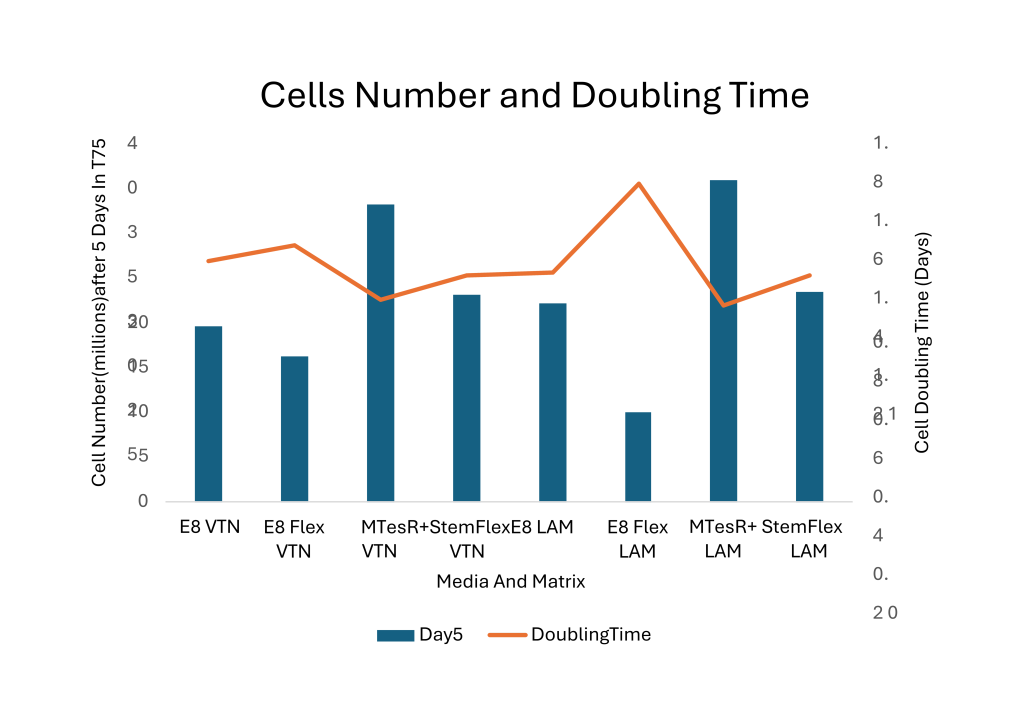
The study also showed meaningful differences in growth rate and doubling time between the culture conditions.
mTeSR Plus combined with either Vitronectin or Laminin-521 produced some of the shortest doubling times observed, while StemFlex supported stable growth across both matrices.
E8 with Laminin-521 also showed growth comparable with the E8 and Vitronectin control.
Taken together, the findings demonstrate why media and matrix decisions need to be considered as combinations rather than independently. The optimal medium may depend on the matrix being used and, equally, the preferred matrix may depend on the wider process requirements.
Operational Simplicity Matters Too
As an iPSC process grows in scale, operational considerations become increasingly important.
E8 Flex, StemFlex and mTeSR Plus allow alternate-day feeding, compared with the more frequent feeding associated with standard E8 culture.
That reduced feeding frequency can have benefits beyond media consumption. As processes scale, fewer feeds can reduce operator interventions, routine handling and the operational burden associated with maintaining cultures over extended expansion periods. It can also help simplify scheduling and workflow design, which becomes increasingly important when multiple cultures or larger manufacturing campaigns are being managed in parallel.
The results demonstrated how feeding frequency, growth performance and raw-material cost can be considered together when designing more efficient iPSC expansion workflows. Within the conditions evaluated in this study, some media and matrix combinations provided a stronger balance across these parameters than others.
Cost Efficiency Starts With Process Design
Raw-material costs can accumulate quickly during repeated cell expansion, particularly as processes move towards larger-scale manufacturing.
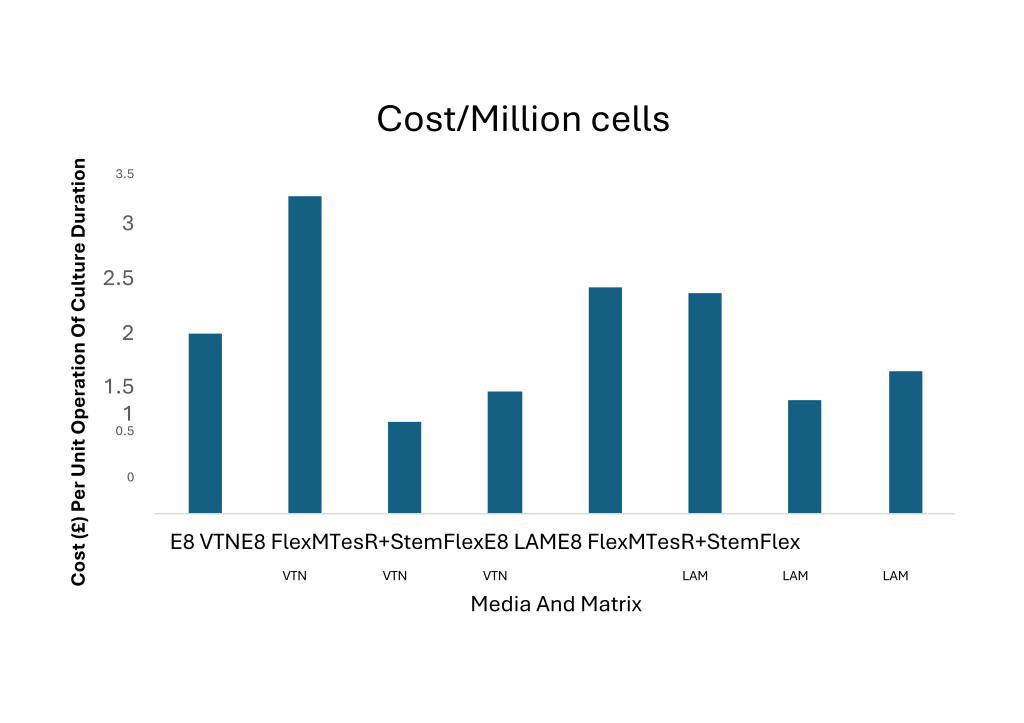
The study therefore considered cost per million cells alongside biological performance.
Among the combinations evaluated, differences were observed in cost per million cells, stability and growth consistency. These findings highlight the value of considering raw-material cost alongside biological performance, rather than assessing either parameter in isolation.
This is an important reminder that cost optimisation in cell therapy manufacturing does not necessarily mean simply selecting the lowest-cost material.
A more useful question is: which combination delivers the required cell performance most efficiently and consistently?
Building Robust iPSC Processes for the Long Term
The findings demonstrate the importance of assessing iPSC culture conditions holistically.
An effective culture platform needs to balance several interconnected factors:
- Cell health and morphology
- Growth rate and doubling time
- Consistency across passages
- Feeding frequency
- Process variability
- Raw-material usage
- Overall cost efficiency
In this study, the combinations that performed best were those that provided the strongest balance between biological performance and practical manufacturing considerations. Under the parameters evaluated, Vitronectin showed the most consistent matrix performance, while mTeSR Plus and StemFlex demonstrated strong growth characteristics.
For developers of iPSC-derived therapies, these kinds of optimisation studies can help establish more robust processes earlier in development and provide a stronger foundation for future scale-up and manufacturing.
At RoslinCT, process development is about more than achieving cell growth. This type of optimisation forms part of the broader work required to reduce unnecessary cost, optimise workflows and understand how each element of a culture system interacts to support robust, reproducible and scalable manufacturing processes.
RoslinCT does not specifically endorse the products referenced in this study, and other products are available.